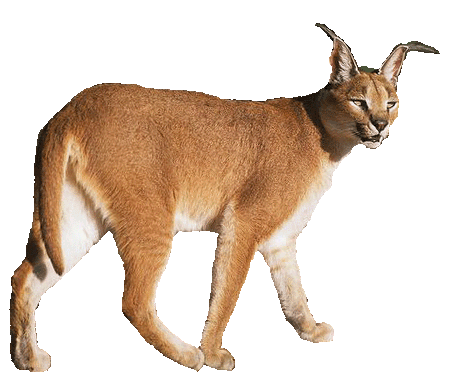
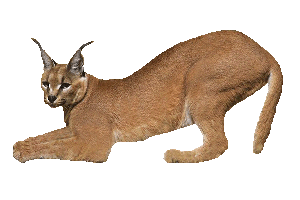
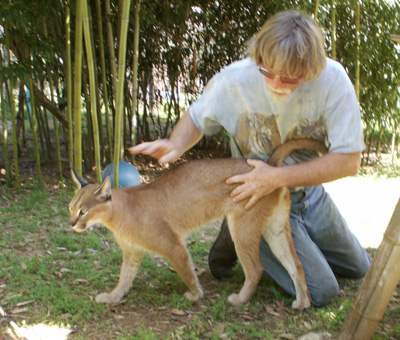
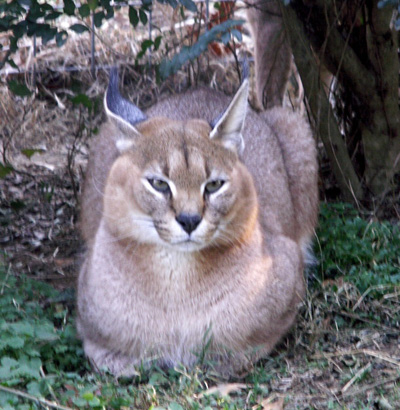
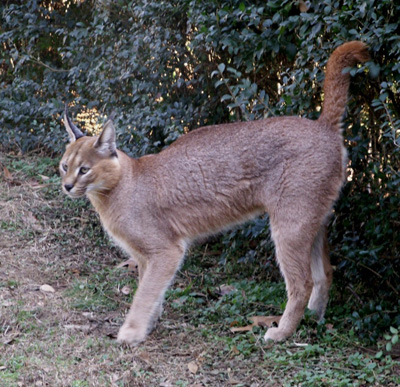
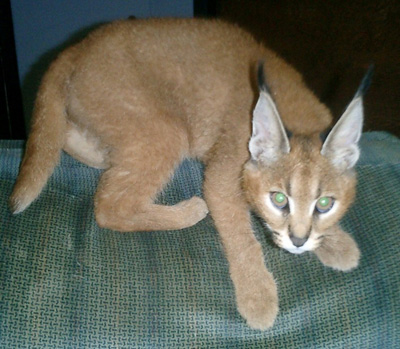
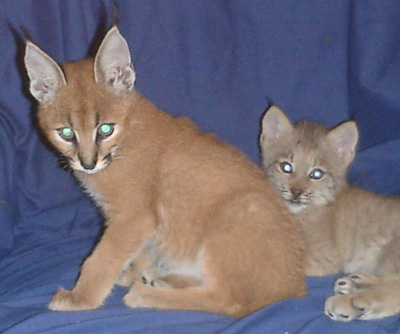
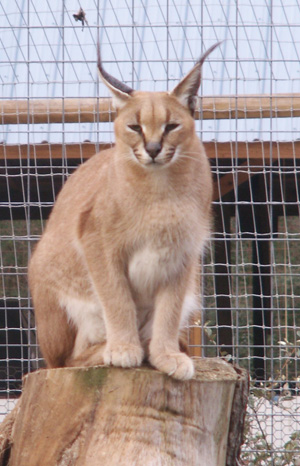
Felis caracal, Caracal adults average 25 to 40 pounds, though some males
can reach 50 or more pounds. It is common for caracals to be
food aggressive and this contributes to over-feeding and
obesity. Provide a quite place to feed your caracal and if it
cohabitates with other felines, separate them for feeding time.
Caracals are excellent jumpers, and have very swift
reactions. They are intelligent creatures. Caracals can purr,
but often times it is very soft. An owner can feel a purr on the
neck, rather than hear it. A happy caracal will express joy by
vocalizing a ‘trill’ a bird-like sound that denotes a happy
greeting. Caracals reliably respond to a human imitation of this
sound. They will come out of hiding, or relax when they are
apprehensive, intimidated, or insecure.
Caracals are more predatory than the similar sized African
serval. In Africa they have evolved to hunt larger prey such as
dik-dik and other small antelope. Caracals are also guilty of
killing the young of domestic livestock making them nuisance
animals to the South African ranchers.
Like servals and
other wild feline species, both male and female caracals will
scent mark. Additionally, caracals have a tendency to void on
fluffy surfaces, such as down quilts, pillows, or clothing left
on the floor. This behavior can be dealt with by always picking
up dirty laundry, and litter box training the feline.
Copyright© 2008 & 2009
N.O.A.H.
Feline Conservation Center
All
rights reserved.
Site design by Gary Fulgham